Lovable— AI app builder from plain-language prompts.
Lovable is a Swedish "vibe coding" platform that turns a plain-language prompt into a working full-stack web app — front-end, back-end, and database — that can be edited by chat and deployed in one click, aimed at the 99% of people who can't code.
Notable milestones from Lovable’s journey — funding rounds, launches, and other moments worth knowing.
acquisition
Lovable brings Radish AI's agent infrastructure team in-house
Lovable acquired the team behind Radish AI, whose platform was built to deploy and scale complex AI agents with privacy and security controls. Its three co-founders joined Lovable engineering across London and Stockholm, with Nirman Gupta set to lead engineering for business agents from the new London hub.
Lovable opens London as its second product and engineering hub
Lovable opened its first London office, making the city its second engineering, product and design hub after Stockholm. The company had 70 people in London across research, infrastructure, security and go-to-market roles, with plans to reach 100 by year-end; the UK was its third-largest market by paying active users.
London became Lovable's second engineering, product and design hub after Stockholm.
Lovable acquires Sutro to make software behavior easier to inspect
Lovable acquired Sutro, bringing its language, compiler and backend platform for making application rules explicit into the company. Sutro founder Tomas Halgas and three engineers joined Lovable, with Halgas taking on technical evangelism as the app builder pushes further into trustworthy production software.
Lovable turns Salesforce data into native team-built apps
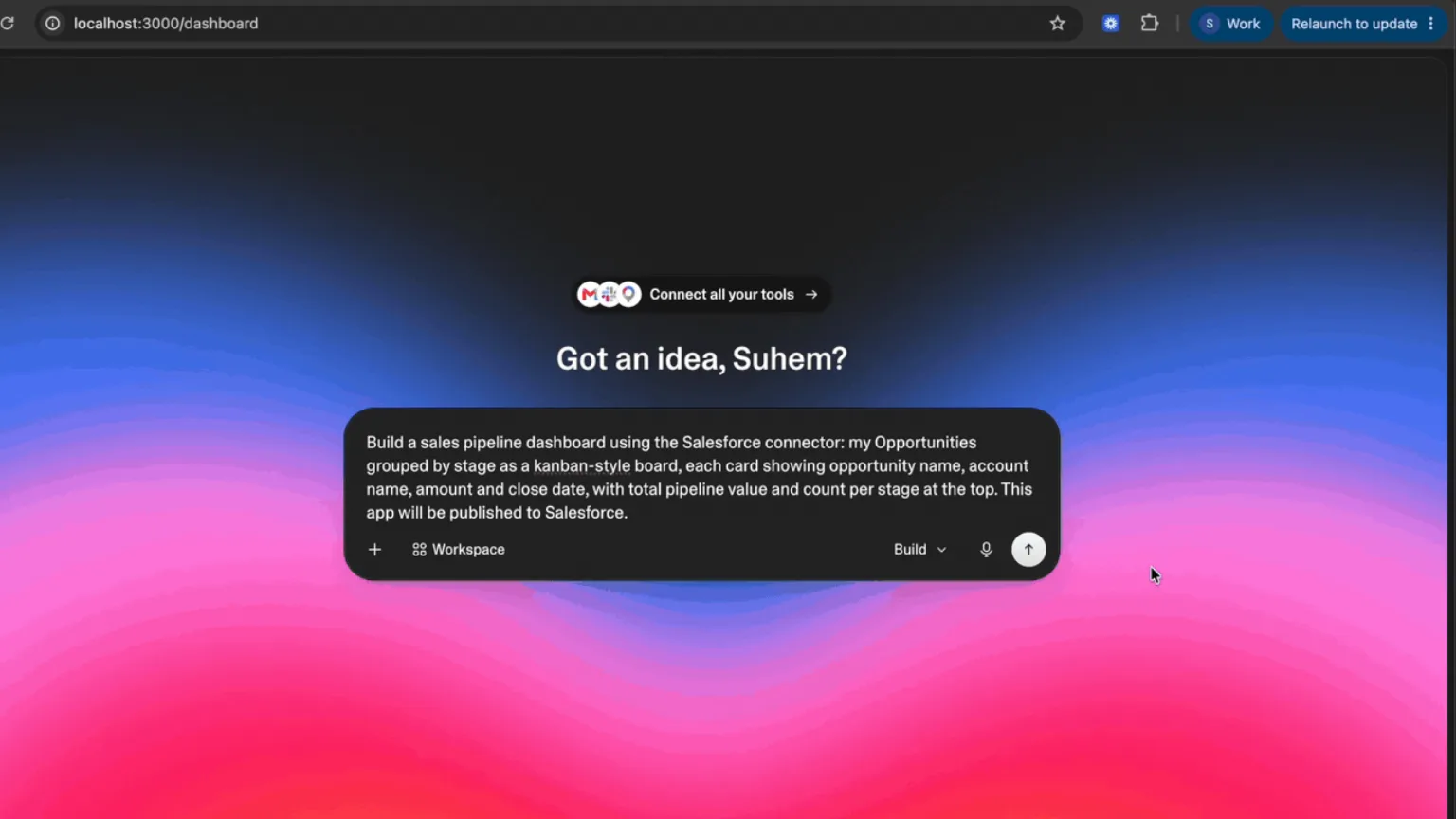
Lovable connected its app builder to Salesforce's Headless 360, letting teams create permission-aware dashboards and pipeline views that run as pages inside Salesforce while retaining live system-of-record data. The launch also brought Lovable into Slack and Slack Code, extending the workflow from Salesforce data to collaborative app and agent building.
The integration turns a Salesforce-connected natural-language request into an app that can be published inside Salesforce.
Menlo Ventures led and EQT's Scaleup Europe Fund co-led Lovable's $400M Series C, lifting the Swedish app builder to a $13.3B valuation. Less than two years after launch, the company said users had made more than 60M projects and Lovable-built apps were receiving over 900M visits a month.
Lovable dedicates Cerebras capacity to keep AI software creation interactive
Lovable committed selected latency-sensitive workloads to dedicated Cerebras inference capacity, pairing its software-creation platform with wafer-scale hardware designed to shorten each model-response loop. The companies said they would explore product experiences enabled by faster inference; by the announcement, users had built more than 50 million Lovable projects.
First coding-agent platform certified under AIUC-1
Lovable became the first AI coding-agent platform certified to AIUC-1, an independently verified security, safety and reliability standard for AI agents. The standard covers 51 requirements, including secrets management, secure code-generation defaults, sandboxed execution, human oversight and enterprise governance.
Lovable apps become MCP tools inside ChatGPT and Claude
Lovable let any publicly published app expose a hosted MCP server, so users can call its actions from ChatGPT, Claude, and other MCP clients. The platform generates a suggested action scope from the app's logic, keeps it aligned with each published version, and uses OAuth by default for access control.
Lovable passed $500M in annualized revenue run rate less than four months after reporting $400M. By the same update, users had built more than 50M projects on the platform, with creation accelerating to one million new projects each week.
$400M ARR — and $100M of it added in a single month
By February 2026 Lovable had crossed $400M ARR, adding $100M in one month with a team of just 146 — roughly $2.7M of revenue per employee. The company says more than half of the Fortune 500 now use the platform.
$330M Series B at $6.6B — a 3.7x markup in five months
CapitalG and Menlo Ventures co-led a round that nearly quadrupled the valuation just five months after the Series A, with NVentures, Salesforce Ventures, Databricks Ventures, and Khosla Ventures joining. ARR had doubled to over $200M between July and November, with customers like Klarna and Uber.
Lovable went from $1M to $100M ARR in eight months — outpacing Cursor, Wiz, OpenAI, and Slack — with 10M+ projects built and 100,000 created a day, and no spend on paid acquisition.
Lovable's $1M-to-$100M climb against the previous record holders.
$200M Series A at a $1.8B valuation — a unicorn in eight months
Accel led one of Europe's largest-ever Series A rounds, making Lovable a unicorn just eight months after launch, on a pitch to "empower the 99% who can't code to build production-grade software by talking to AI."
$15M pre-Series A on the back of explosive early traction
Eight weeks after opening access, Lovable was at $17M ARR with 500,000 users, 30,000 paying customers, and 25,000 new apps a day — built on just $2M of a €6.8M pre-seed. Creandum and Visionaries Club led the round, joined by angels including Charlie Songhurst and Hugging Face's Thomas Wolf.
GPT Engineer becomes Lovable and opens to everyone
The team rebranded the GPT Engineer app to Lovable and launched open access — a chat-first builder that turns a description into a deployable full-stack app, no setup required. It immediately became the platform's growth engine, with tens of thousands of new projects spun up daily.
Real apps built by chatting with Lovable — portfolios, blogs, presentation tools, and storefronts.
Two Swedes turn a viral open-source coding experiment into a company
Anton Osika's open-source GPT Engineer — which let an LLM scaffold a whole app from a prompt — raced to tens of thousands of GitHub stars in 2023. With Fabian Hedin he turned it into a commercial product and founded the company in Stockholm.
Anton Osika (CEO) and Fabian Hedin (CTO) — GPT Engineer's authors, later Europe's fastest-growing software founders.



 EQT Ventures
 Salesforce Ventures
 Khosla Ventures

 Accel
 Creandum
 Visionaries Club

