mimic robotics— Dexterous robotic hands and AI models for industrial manipulation.
mimic robotics builds dexterous humanoid robotic hands paired with standard industrial arms, driven by foundation models that learn manual tasks from human demonstrations. An ETH Zurich spin-off, it targets manufacturing, assembly, and logistics work too intricate for conventional automation.
Notable milestones from mimic robotics’s journey — funding rounds, launches, and other moments worth knowing.
partnership
FLUX-mimic puts a multimodal world model on Audi robots
mimic and Black Forest Labs paired FLUX 3 with mimic's video-action-model recipe and data to create FLUX-mimic, tested in Audi production. On a real soft-body kitting task, mimic reported 95% out-of-the-box success without task-specific fine-tuning, versus 55% for an adapted pi0.5 baseline and 70% for a post-trained flow-matching policy.
FLUX-mimic was tested and deployed with Audi for industrial manipulation.
M1 hand and U1 wearable launch as one dexterity stack
mimic unveiled the M1, a tendon-driven hand with 15 active degrees of freedom across 21 joints, and the U1 exoskeleton, which captures human demonstrations with matching kinematics, contact geometry and camera perspective. Custom low-latency middleware and Video Action Models complete the vertical stack, keeping hand morphology fixed from pre-training through factory deployment instead of translating human data to a two-finger gripper.
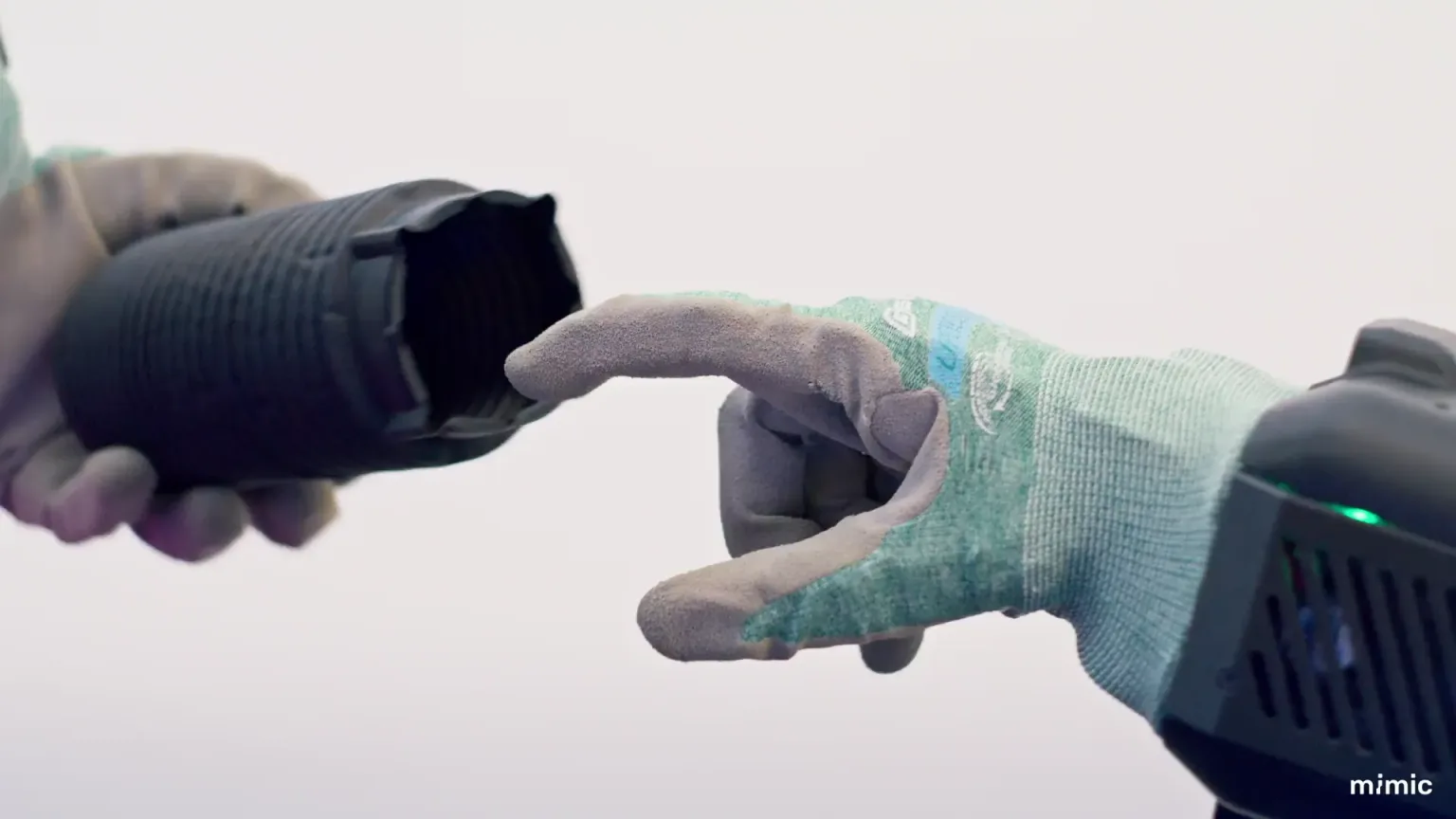
The M1 launch reel moves from fine contact and human-like motion to payload, impact and dual-arm manipulation tests.
mimic-video turns video models into robot policies
mimic released mimic-video, a Video-Action Model that swaps a vision-language backbone for NVIDIA's Cosmos-Predict2 video model and trains a small action decoder on top. The company reported that about 500 bimanual trajectories were enough for real-robot success, with simulated benchmarks showing 10x better sample efficiency and 2x faster decoder convergence than a pi0.5-style VLA baseline.
mimic-video uses the video model as the policy backbone and leaves only action decoding to robot-specific training.
Elaia and Speedinvest co-led an oversubscribed round — with Founderful, 1st Kind, 10X Founders, 2100 Ventures and the Sequoia Scout Fund joining — taking total funding past $20M. mimic said it was already piloting with Fortune 500 manufacturers, global automotive brands and multinational logistics providers.
Round
Seed
Raised
$16M
Led by
Elaia, Speedinvest
The deployable line-up — fixed and mobile arm stations carrying mimic's hands.
mimic's edge is its data engine: skilled operators wear capture devices while doing real factory work, and the recorded movements train imitation-learning models that let the hands reproduce human technique and self-correct as objects shift.
Human demonstrations, captured live, become training data for the hands.
mimic took the third and final stage of Switzerland's Venture Kick, adding CHF 150,000 in non-dilutive backing to develop its robotic-transformer-driven manipulation models.
$2.5M pre-seed to put a dexterous hand on a robot arm
Founderful led the first round, joined by another.vc, Tiny.vc and angels. The demo that sold it: a tendon-driven humanoid hand picking up a croissant and making coffee — fine-motor tasks conventional grippers can't touch.
Round
Pre-Seed
Raised
$2.5M
Led by
Founderful
The croissant pick mimic used to show off fine-motor dexterity.
An ETH Zurich spin-off bets on hands, not humanoids
Five founders out of ETH Zurich's Soft Robotics Lab — Stefan Weirich, Stephan-Daniel Gravert, Elvis Nava, Benedek Forrai and lab director Robert Katzschmann — started mimic on a contrarian thesis: skip the full-body humanoid and put human-level dexterity into a hand that bolts onto a conventional robot arm.
The founding team, spun out of ETH Zurich's Soft Robotics Lab.




 Elaia
 Speedinvest


